
AI Can Design a Part, But Can It Build It?
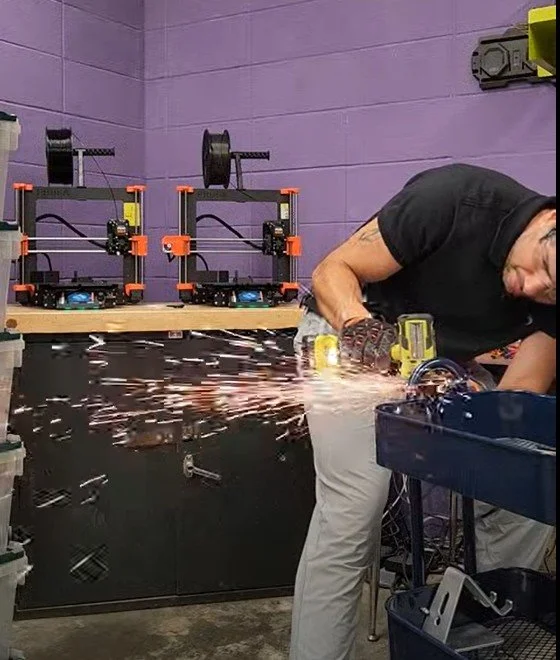
3D printers and me cutting a metal piece at Westhill
Here I am thinking that shop classes at schools across the country would be safe from any AI tools giving students a shortcut into doing their work.
Sure, LLM’s have made it hard for teachers to assign papers while confiding that their students have done 100% of the work. Math teachers have had similar problems with photomath and other apps capable of solving any problems via a single picture. But a new AI tool might soon give shop teachers teaching Computer Aided Design (CAD) a new challenge.
I discovered a new AI tool that is now able to generate geometrically valid and manufacturable CAD parts based on user input. In simple terms, it works almost like ChatGPT for CAD design. As a technology teacher, this immediately made me reflect on the future of my field. I have spent full units teaching students Fusion 360, now Autodesk Fusion, so they can design parts for their woodworking and power mechanics projects. With this tool, students can design parts in minutes. When this AI tool becomes widely available, students may naturally ask why they need to learn CAD, drafting, or traditional shop skills at all.
A student may soon be able to generate a CAD file, but they still need to understand how to safely set up a machine, hold tolerances, inspect a part, troubleshoot errors, and make adjustments in the physical world outside a screen
When I taught calculus years ago, I encouraged program their TI-83 calculators to verify solutions but regrettably a few became too dependent on the calculator to solve their work. Even then, my goal was not to reject technology, but to stay ahead of it by challenging students to think more deeply. I believe the same is true in technology education today. AI may be able to generate a design, but students still need the judgment to evaluate whether that design is safe, accurate, manufacturable, and appropriate for the material, machine, and purpose of the final product or its role in it.
Very interesting times we live in! Human skills, such as ingenuity - fine motor control - and sound judgment I predict will keep the majority of us employed for the near future.